Speaker
Zeyad el Nabolsy
Assistant Professor
Department of Philosophy, York University (CA)
Lecture
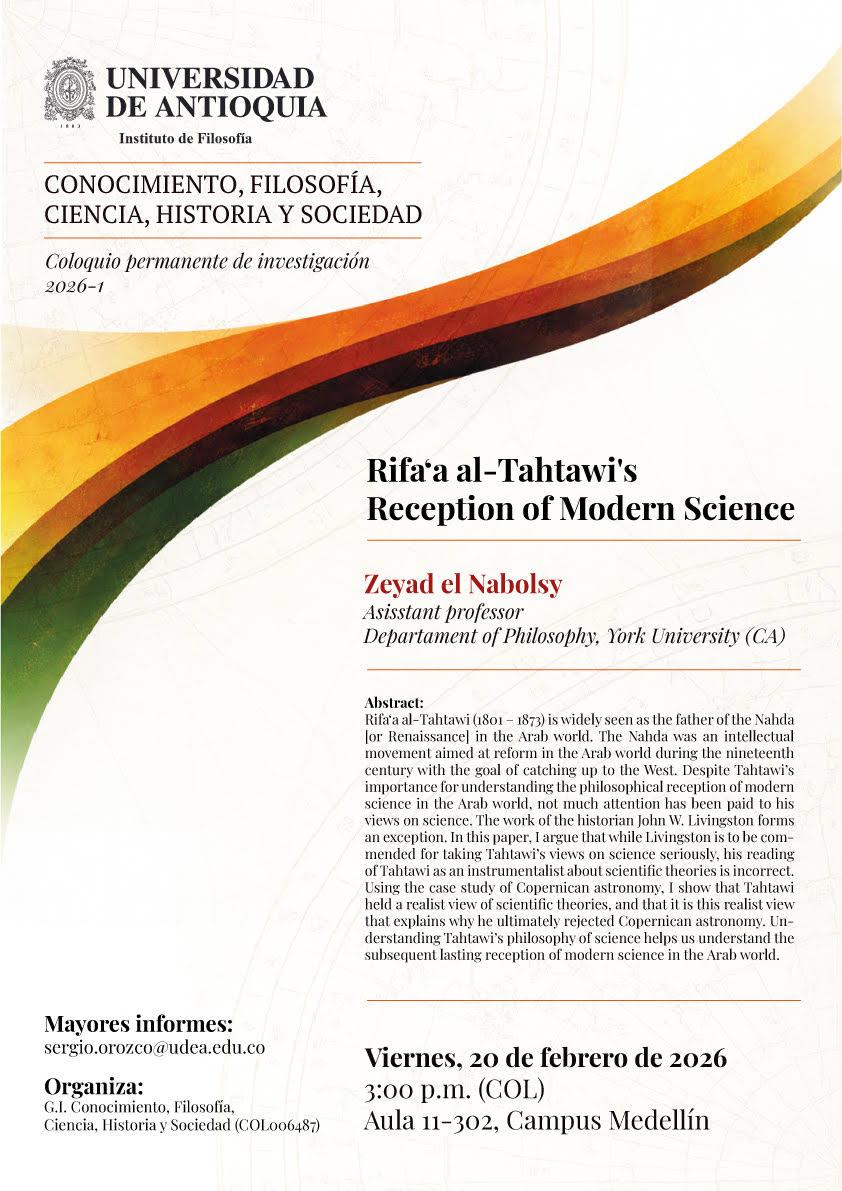
Rifa‘a al-Tahtawi’s Reception of Modern Science
Rifa‘a al-Tahtawi (1801–1873) is widely regarded as the father of the Nahda—the nineteenth-century Arab Renaissance. The Nahda was an intellectual movement aimed at reform in the Arab world, seeking to engage critically with modernity and to situate Arab societies within emerging global scientific and cultural transformations.
Despite Tahtawi’s importance for understanding the philosophical reception of modern science in the Arab world, relatively little attention has been paid to his views on science. An important exception is the work of the historian John W. Livingston. In this lecture, Professor el Nabolsy argues that while Livingston deserves credit for taking Tahtawi’s reflections on science seriously, his interpretation of Tahtawi as an instrumentalist about scientific theories is mistaken.
Focusing on the case of Copernican astronomy, the lecture shows that Tahtawi held a realist view of scientific theories, and that this realist commitment helps explain his eventual rejection of the Copernican system. Understanding Tahtawi’s philosophy of science thus sheds light on the longer-term reception of modern science in the Arab world and contributes to broader discussions about realism, reform, and intellectual transformation in non-European contexts.
Date and Venue
Friday, 20 February 2026
3:00 p.m. (COL)
Room 11–302, Medellín Campus
Universidad de Antioquia